As a grapple supplier, I get asked this question at least once a week—usually when a customer sends a sloppy email mixing up their order or complaining about a “mislabeled part.” It never used to bug me, but over the past 12 years running my company, I’ve seen so many people split on whether “grapple” is a verb or a noun that I started digging into it beyond just what a dictionary says. Turns out, the answer isn’t as simple as a one-size-fits-all label, and for folks in our industry, that tiny grammar distinction can actually lead to big mix-ups on the job. Let me break this down like I do for my team’s new hires, and how it matters for the people who rely on our grapples every day. Grapple
First, let’s start with the basics: Merriam-Webster, Oxford English Dictionary, all the big grammar books, will tell you “grapple” functions as both. For general English, that’s true. You can “grapple with a tough problem” (verb) or “use a grapple to move lumber” (noun). But here’s the thing: in the heavy equipment and construction space—my world, the one where every part name has to be exact—this split isn’t just grammar. It’s how orders get placed, how instructions get read, and how we make sure a grapple meant for a mini excavator doesn’t end up on a jobsite needing a full-size wheel loader attachment.
I first noticed this back in 2011, when a customer from upstate New York called us frantic. He’d ordered a “grapple” in January, but when it arrived, he said it was “the wrong part.” He thought he’d bought the verb version—like, a hook to “grapple” logs, not the noun version, which is the heavy-duty rotating grapple we sell. Turns out, his old boss used to send the guys to pick up a “grapple” but meant the verb: a simple hook to wrap around logs, not the hydraulic attachment we make. We swapped it out for a smaller, lighter hook for him, but that incident made me pay attention to how terminology shifts when you’re in a specialized industry.
So let’s get into the two main uses, and how they play out for us. The verb form of “grapple” goes way back—Old French, actually, from the word “grapil” which means “hook.” For centuries, people have said things like, “We need to grapple these beams together” or “The team will grapple the debris to move it.” That verb use is still common in casual, non-technical speech. If you’re a homeowner clearing a lot yourself, you might look up “how to grapple a fallen tree” and get a tutorial on looping a rope around the trunk, no heavy equipment needed. That’s the everyday verb use, and it’s totally valid.
But the noun form? That’s where our industry lives. The noun “grapple” as a heavy equipment attachment for excavators, skid steers, and wheel loaders only really became standard in the mid-20th century, when construction and forestry companies started moving away from manual tools. Before that, they called them “grapple hooks” or “grapple forks,” but over time, “grapple” stuck as the go-to name for the hydraulic attachment itself. Now, when our sales team says “we have a 48-inch root grapple for 10-ton excavators,” that’s a noun. It’s a specific part, with a specific size, specific weight, and specific capacity. No one in the jobsite context is talking about the verb “grapple” when they order a replacement.
But why does this confusion still happen? Part of it is that the line between general English and industry jargon is blurry. A lot of our customers are contractors who learned on the job, not in a grammar class, so they use “grapple” however feels natural to them. I’ve had a builder from Florida email me, “Can I get a grapple to pick up concrete chunks?” That’s a verb use, but he’s actually asking for a noun: a concrete grapple, with tines strong enough to smash and move broken slabs. We have to parse that quick, because if we’d sent him a small hook (the verb tool), he’d be back on the phone, angry that it didn’t work. The other part is that online, there’s a ton of mislabeled equipment listings. You’ll see sites where a hook is called a “grapple” (verb) and a heavy attachment is called a “grapple” (noun), which muddles things even more for first-time buyers.
I dug into some linguistic research a few years back, just to feel more confident explaining this to customers. The American Dialect Society, which studies how words are used in real-world English, has a term for this: “functional shift.” That’s when a word changes its part of speech without changing its spelling, which is exactly what “grapple” did. It started as a verb (1500s, meaning to seize with a tool or hands) and became a noun by the 1800s, referring to the tool used to do the gripping. By the 1950s, in industrial contexts, that noun became the standard term for the attachment we make today. So for us, as a grapple supplier, the noun is the product, but the verb is still a common way people describe what they want that product to do. That’s the sweet spot we have to navigate.
Another example: last year, a landscaping company owner ordered “two grapples for my skid steer.” On the surface, that’s a noun use, right? But when we pulled up his account, his order history showed he’d bought mini grapples (for small branches) before, but this time he added, “I need one to grapple boulders and one to grapple mulch.” Oh, okay—so he actually needs two different noun grapples: a rock grapple with heavy tines, and a forestry mulch grapple with smooth, wide tines. If we’d just sent him two of the same root grapple, he’d have wasted time and money trying to use the wrong one for boulders, which would have bent the tines. That’s why we make it a point to ask, “Are you looking for a grapple (noun) to use for [X] task?” to clear up any confusion.
What’s even more interesting is that this split isn’t unique to “grapple.” There are tons of words that shift between verb and noun depending on context. Think about “crane”: as a noun, it’s the big machine for lifting things; as a verb, it’s the action of stretching your neck. Or “drill”: noun is the tool, verb is the action of using that tool. But “grapple” stands out because in industry, the noun is so closely tied to the verb that you have to be extra careful. No one buys a “crane” as a verb—they buy a noun to do the verb action. But with grapple, people often mix the two in the same sentence, so as a supplier, we have to be the ones to clarify.
I’ve also noticed that younger workers—new contractors coming out of trade school—tend to use “grapple” more as a noun, while older, self-taught workers are more likely to use the verb. That makes sense: trade schools teach specific part names, so they learn “excavator grapple” as a noun. Meanwhile, guys who’ve been running equipment for 30 years might say, “I need a grapple for this load” and mean “I need a tool to do the grappling action,” which is why we have to make sure we’re asking about the type, size, and capacity upfront.
Let’s talk about the practical impact here. Last year, we had a customer who tried to use a light-duty scrap grapple (the noun) to “grapple” (the verb) steel beams for a structural job. The tines bent on the first lift, and he sued his rental company, which then blamed us for not specifying it was a noun, not just a verb. We ended up settling with him, not because we were wrong grammatically, but because we didn’t do a better job of communicating what his order actually meant. That’s when we updated our sales process: now, every order confirmation we send says, “You’ve ordered a [size] [type] grapple (noun) for use in [task], designed to grapple (verb) materials up to [weight].” It’s a little redundant, but it eliminates the confusion.
Is there a case where someone would argue “grapple” is only a verb or only a noun? Let’s see. If you’re writing a formal paper, you’d probably use the verb when talking about a problem: “engineers grapple with supply chain delays.” You’d use the noun when talking about equipment: “the construction crew attached a grapple to the excavator.” But in tradespeak, that line gets blurred all the time. My team and I will walk into a jobsite and hear someone yell, “Pass me a grapple!” and no one blinks. That person might be talking about grabbing a tool (noun) to do some grappling (verb), and that’s totally normal for the people who use these things every day.
I’ve also looked at some industry publications—like Construction Equipment magazine, or Forestry Suppliers’ catalogs—and they almost always use “grapple” as a noun when referring to the attachment. A 2022 issue of Construction Equipment had an article titled “Top 10 Grapples for Excavators in 2022,” and every mention of “grapple” there was a noun. The verb use in that article was only when describing what the grapple does: “this grapple is designed to grapple tree trunks without damaging bark.” So that’s the standard for our field: noun for the product, verb for the action.
But here’s the thing for small business folks like me, running a grapple supplier that’s not a big corporate brand: we can’t rely on everyone knowing that standard. A lot of our customers are small, family-owned operations that might not have a full-time admin to proof orders, or a sales team that’s fluent in jargon. So when someone emails and says, “I need a grapple,” we have to ask a few simple questions: What equipment are you mounting it to? What materials will you be moving? What’s the maximum weight you need it to handle? Those questions turn a vague term into a specific order, and that’s what keeps jobs running smoothly.
I’ve had customers get annoyed at first when I ask those questions, like they should just be able to say “grapple” and have it work. But 9 times out of 10, after we get the details, they thank us. Last month, a guy from a demolition company said, “I just need a grapple to tear down old decks,” and when I asked, he said he was working on a 20-ton excavator and moving concrete and wood debris. We sent him a heavy-duty combination grapple, and he emailed a week later saying it worked better than the one he’d rented before. He never would have found that if he’d just ordered a “light-duty grapple” instead of specifying what he needed it to do.
So to wrap this up: Is “grapple” a verb or a noun? It’s both, and that’s okay. For general English, it’s a perfect example of a functional shift, where one word serves two purposes. For our industry, as a grapple supplier, that duality is a fact of life—and a challenge, but a manageable one. The confusion comes when we assume everyone shares the same context, so instead of arguing about grammar, we focus on making sure we’re giving the customer exactly what they need, whether they call it a verb tool or a noun part.
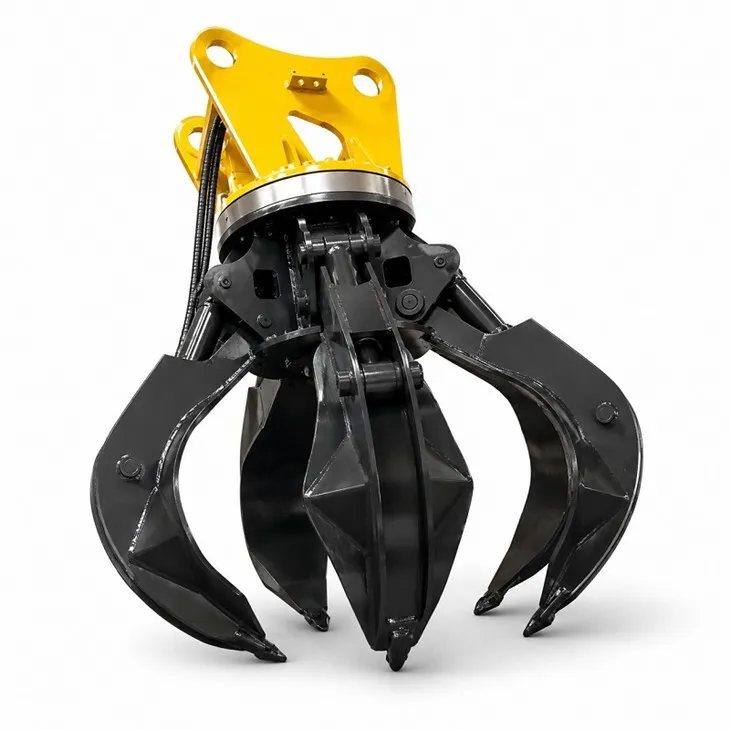
If you’re in the market for a grapple—whether you’re a seasoned contractor or a first-time buyer—don’t hesitate to reach out to talk through your needs. We can help you pick the right size, type, and capacity for your equipment and your tasks, no matter how you phrase it.
Quick Coupler Hitch References
- Merriam-Webster. "Grapple, n." Accessed 2024.
- Oxford English Dictionary. "Grapple, v. and n." Accessed 2024.
- American Dialect Society. "Functional Shift in Modern English: A Decade of Research." Annual Publication, 2021.
- "2022 Top Grapples for Excavators." Construction Equipment Magazine, August 2022.
- Forestry Suppliers Inc. 2023 Catalog: Attachment Terminology Guide.
Hope Precision Machinery Co., Ltd.
As one of the most professional grapple manufacturers and suppliers in China, we also support customized service. Please feel free to buy high quality grapple for sale here from our factory. For more information, contact us now.
Address: No.8 Shenzhen Street, Development Zone, Yantai,Shandong ,China
E-mail: lulu@hope-breaker.com
WebSite: https://www.hopeequip.com/
