What is the impact of temperature on the performance of an industrial dehumidifier?
As a seasoned supplier of industrial dehumidifiers, I’ve witnessed firsthand the critical role that temperature plays in the performance of these essential machines. Industrial dehumidifiers are used in a wide range of settings, from factories and warehouses to data centers and laboratories, to maintain optimal humidity levels and protect equipment and products from damage. Understanding how temperature affects their performance is crucial for ensuring their effectiveness and efficiency. Industrial Dehumidifier
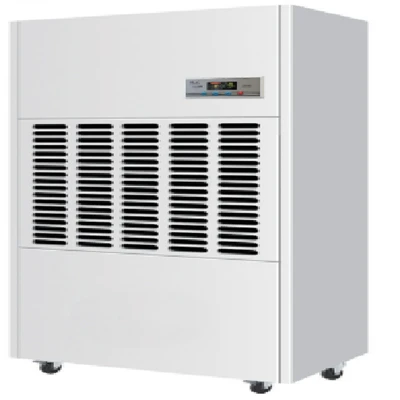
The Basics of Industrial Dehumidifiers
Before delving into the impact of temperature, let’s briefly review how industrial dehumidifiers work. There are two main types of industrial dehumidifiers: refrigeration dehumidifiers and desiccant dehumidifiers.
Refrigeration dehumidifiers operate on the principle of condensation. They draw in moist air, pass it over a cold coil, which causes the water vapor in the air to condense into liquid water. The condensed water is then collected in a reservoir, and the dry air is reheated and released back into the environment. These dehumidifiers are most effective in moderate to high humidity conditions and at temperatures above 4°C (39°F).
Desiccant dehumidifiers, on the other hand, use a desiccant material, such as silica gel or activated alumina, to absorb water vapor from the air. The desiccant is then regenerated by heating it to release the absorbed moisture. Desiccant dehumidifiers are more suitable for low humidity and low – temperature applications, as they can operate effectively even at temperatures below freezing.
Impact of Temperature on Refrigeration Dehumidifiers
Cooling Efficiency
Temperature has a significant impact on the cooling efficiency of refrigeration dehumidifiers. When the ambient temperature is high, the compressor in the dehumidifier has to work harder to cool the refrigerant and maintain the cold surface temperature of the evaporator coil. As a result, the energy consumption of the dehumidifier increases, and its cooling capacity may decrease.
For example, in a very warm environment (say, above 35°C or 95°F), the refrigerant may not be able to cool down as effectively, leading to a reduced temperature difference between the incoming moist air and the evaporator coil. This means that less water vapor will condense, and the dehumidification rate will drop. In extreme cases, the high temperature can cause the compressor to overheat, leading to system shutdown and potential damage.
Frost Formation
Conversely, when the temperature is too low (below 4°C or 39°F), frost can form on the evaporator coil of refrigeration dehumidifiers. Frost acts as an insulator, reducing the heat transfer between the air and the coil. As a result, the dehumidification capacity of the unit is significantly impaired. When frost builds up, the dehumidifier may have to enter a defrost cycle, during which the compressor stops, and a heater is used to melt the frost. This not only interrupts the dehumidification process but also consumes additional energy.
Impact of Temperature on Desiccant Dehumidifiers
Absorption Rate
Temperature affects the absorption rate of desiccant dehumidifiers. The desiccant material’s ability to absorb water vapor is influenced by the temperature and humidity of the surrounding air. In general, desiccants absorb more moisture at lower temperatures and lower relative humidities.
At high temperatures, the kinetic energy of water vapor molecules increases, making it more difficult for the desiccant to capture and hold them. As the temperature rises, the desiccant’s equilibrium capacity for moisture decreases. This means that the desiccant will reach its saturation point more quickly and will need to be regenerated more frequently, reducing the overall dehumidification efficiency of the unit.
Regeneration Process
The regeneration process of desiccant dehumidifiers is also temperature – dependent. To release the absorbed moisture, the desiccant needs to be heated to a certain temperature. The higher the temperature, the faster the moisture is released from the desiccant. However, excessive heat can damage the desiccant material over time.
In low – temperature environments, it may be more challenging to achieve the required regeneration temperature efficiently. This can lead to incomplete regeneration, reducing the desiccant’s ability to absorb moisture in subsequent cycles.
Optimal Temperature Ranges for Different Applications
Warehouses and Storage Facilities
In warehouses and storage facilities, maintaining an optimal temperature range is crucial for protecting stored goods from damage due to moisture. For refrigeration dehumidifiers, the ideal operating temperature is typically between 10°C and 30°C (50°F – 86°F). Within this range, the dehumidifier can operate efficiently, removing moisture from the air and preventing the growth of mold and mildew on stored products.
If the temperature in the warehouse drops below this range, it may be necessary to switch to a desiccant dehumidifier to ensure continuous dehumidification. On the other hand, if the temperature rises above 30°C, additional cooling measures may be required to improve the performance of the refrigeration dehumidifier.
Data Centers
Data centers require precise control of humidity and temperature to ensure the proper functioning of servers and other IT equipment. The optimal temperature for a data center is usually maintained between 18°C and 27°C (64°F – 81°F). In such environments, refrigeration dehumidifiers are commonly used.
The relatively stable temperature range in data centers allows refrigeration dehumidifiers to operate at peak efficiency. However, it is important to monitor the temperature closely, as even small fluctuations can affect the dehumidification performance and the overall reliability of the IT infrastructure.
Laboratories
Laboratories often have strict requirements for humidity and temperature control, depending on the type of experiments being conducted. For many laboratory applications, a temperature range of 20°C – 25°C (68°F – 77°F) is ideal.
Both refrigeration and desiccant dehumidifiers can be used in laboratories, depending on the specific needs. For general laboratory use, refrigeration dehumidifiers are sufficient in most cases. However, for applications that require very low humidity levels or operate at low temperatures, desiccant dehumidifiers may be the better choice.
Strategies to Mitigate Temperature – Related Performance Issues
Temperature Control in the Environment
One of the most effective ways to mitigate the impact of temperature on industrial dehumidifiers is to control the ambient temperature in the environment where they are installed. This can be achieved through the use of heating, ventilation, and air – conditioning (HVAC) systems.
In cold environments, heating systems can be used to maintain the temperature above the frost – formation threshold for refrigeration dehumidifiers. In hot environments, air conditioning can be used to lower the temperature and improve the cooling efficiency of the dehumidifiers.
Proper Dehumidifier Sizing and Selection
Proper sizing and selection of dehumidifiers are also crucial. When choosing an industrial dehumidifier, it is important to consider the temperature and humidity conditions of the application environment. For example, in a high – temperature and high – humidity environment, a larger – capacity refrigeration dehumidifier may be required to handle the load.
In low – temperature applications, a desiccant dehumidifier should be selected to ensure reliable operation. Additionally, the dehumidifier should be sized based on the volume of the space and the desired humidity reduction rate.
Regular Maintenance and Monitoring
Regular maintenance and monitoring of industrial dehumidifiers can help to identify and address temperature – related performance issues early. This includes cleaning the evaporator and condenser coils of refrigeration dehumidifiers to ensure optimal heat transfer, checking the desiccant material in desiccant dehumidifiers for degradation, and monitoring the temperature and humidity levels in the environment.
By implementing these strategies, industrial facility managers can ensure that their dehumidifiers operate efficiently and effectively, regardless of the temperature conditions.
Conclusion
In conclusion, temperature has a profound impact on the performance of industrial dehumidifiers. Both refrigeration and desiccant dehumidifiers are affected by temperature in different ways, and understanding these effects is essential for proper selection, operation, and maintenance of these units.
By carefully considering the temperature conditions of the application environment, selecting the appropriate type and size of dehumidifier, and implementing strategies to control temperature and humidity, industrial facilities can ensure optimal performance of their dehumidification systems.
Specialty Dehumidifier If you’re facing challenges with humidity control in your industrial environment and need guidance on selecting the right dehumidifier, or if you’re interested in learning more about optimizing the performance of your existing dehumidification system, we’re here to help. Our team of experts has extensive experience in providing industrial dehumidification solutions tailored to your specific needs. Contact us to start a discussion about how we can assist you in achieving the ideal humidity levels for your operations.
References
- ASHRAE Handbook of Fundamentals. American Society of Heating, Refrigerating and Air – Conditioning Engineers.
- Industrial Dehumidifier Product Manuals from leading manufacturers.
- Research papers on the performance of dehumidifiers in different temperature and humidity conditions.
Hangzhou Dayu HVAC Engineering Co., Ltd.
As one of the most professional industrial dehumidifier manufacturers and suppliers in China, we have world-leading production equipment and strong manufacturing capabilities. If you’re going to buy customized industrial dehumidifier made in China, welcome to get quotation from our factory. For price consultation, contact us.
Address: Room 1004, Building 1, Xicheng Business Tower, Xihu District, Hangzhou City, Zhejiang Province, China
E-mail: info@hi-hvac.com
WebSite: https://www.hi-hvac.com/
