Muslim parents have been urged to encourage the use of the Arabic language among their children at home in daily conversation.
The Deputy Registrar of Yaba College of Technology, Sheikh Sa’eed Salman, gave this charge last Sunday in Lagos.
Sheikh Salman, while fielding questions from our correspondent at Ma’hdu Diraasaatul Qur’an Wal-Lugha’s, Oworonsoki, Lagos suburb, public lecture to mark this year’s World Arabic Language Day (being marked today), said the canvassed approach was not necessarily to impede the children from speaking the existing languages.
The academic, who was the chief host at the event, stated that one of the best ways to make the Arabic language earn appreciative popularity was the use of “short, short expressions” while engaging the young ones at home.
While noting that the learning of Arabic is important for Muslims, as it is the choice of language in most acts of worship, such as the call to prayer and conduct of daily obligatory prayers, Sheikh Salman affirmed that the use of Arabic at home would resonate the importance of the language among children.
“It doesn’t augur well for a Muslim not to be able to speak Arabic, not really as native Arabs, but as little as we can, we should be able to express ourselves like ‘I want this’… and other short constructions,” Sheikh Salman reiterated.
Responding to a question on what could be done to give the day more publicity, the Deputy Registrar urged the organisers not to hesitate in reaching out to like-minded Muslim organisations and bodies subsequently—for collaboration to organise a bigger and far-reaching commemoration ceremony.
While describing Arabic as the identity of Muslims, Sheikh Salman declared that every Muslim has a role to play in entrenching and growing the Arabic language in society.
Against this background, he called on adult Muslims to deploy financial, intellectual, and moral resources, as well as desist from discouraging fellow faithful willing to express themselves in Arabic.
While fielding questions from journalists, the guest lecturer at the event, Ustadh Nasir Alabi, said the Arabic language is a veritable medium to impart divine teachings among adults and children.
Ustadh Alabi, who is the Head Teacher, Centre for Islamic Re-Awakening, Bariga, a Lagos suburb, explained that since the Muslim scripture, the Quran, was revealed in Arabic, the adults are exposed to teachings of Islam as well as learn the language, adding that the same thing applies to the young ones.
He further specified that the use of stories, rhymes, and other literary elements, which the Arabic language contains, were good methods to make Arabic look attractive to children and ignite their interest in it.
While delivering a lecture on the theme “Arabic: A Universal Language” of this year’s commemoration, Ustadh Alabi listed features of language to include: means of communication; must be a tool for invention; must pass through and certify stages of development, affirming that Arabic passed these tests.
Speaking further, Ustadh Alabi, an engineer and lecturer at the Federal College of Fisheries and Marine Technology, Victoria Island, Lagos, disclosed that children could be encouraged to learn the Arabic language by exposing them to it through regular verbal interactions.
The roles of language, including Arabic, Ustadh Alabi indicated, include: deployment as a means of communication; which always comes with invention; development and promotion of entertainment; stressing that Arabic has an edge due to its rich literature, including poetry.
While noting that Arabic is a combination with Hebrew, the specialities he mentioned include the invention of words and the features that suit people and places.
According to Ustadh Alabi, Arabic is considered a universal language because it boasts over 2 million users across the globe, while it is used in commercial and economic activities.
He added that Arabic is a holy language, as the Quran was revealed through it.
The language is also universal; as Ustadh Alabi affirmed, it is used as a language of communication in various academic institutions across the globe.
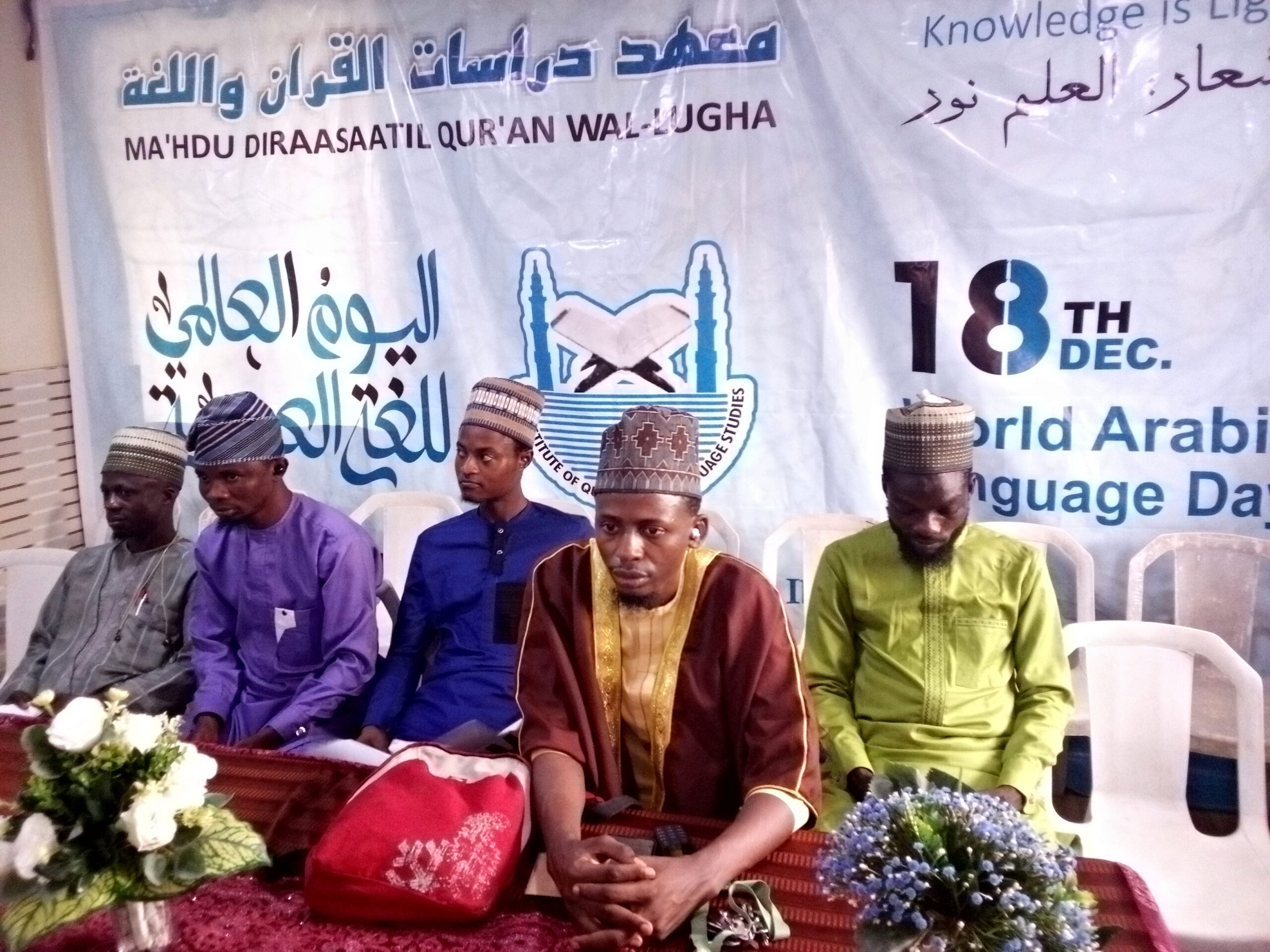
The Mudir of the Arabic and Islamic Studies Institute, Dr. Ridwan Ibrahim, while speaking on what prompted the event, related that Arabic is a unique language; therefore, there was the need for a deliberate and sustainable drive to publicise it, take it to the doorsteps of Muslims, and encourage its usage.
Regarding the role of parents and their wards’ interest in it, Dr. Ibrahim said that parents needed to be more proactive, assertive, and responsible regarding their financial commitment and packaging. He restated that the children should be packaged properly when going to madrasas (Arabic schools), just like it is done when going to conventional schools.
Earlier in his welcome address, Dr. Ibrahim said he was happy that the institute is writing history by becoming “the first celebrant of this great day and specifically being the first to make it laudable with intensive awareness to the good people of Nigeria. We are indeed setting a noble path and pace for others to follow.”
He added that there was no doubt that “we have gathered today for a great goal and a very important goal, and what is this great thing? It is a celebration of International Arabic Language Day… a day to celebrate the Arabic language because it is the day on which it was issued by the United Nations General Assembly and falls on December 18 of each year.”
Dr. Ibrahim disclosed: “World Arabic Language Day is considered one of the most prominent cultural occasions that celebrates the Arabic language. It is a day that highlights the cultural and historical importance of the Arabic language, which is one of the oldest and most influential Semitic languages.
“The United Nations began officially designating this day in 2012, in recognition of the contributions of the Arabic language to enriching human civilisation.
“What does this day require of us, or what are our duties toward this day?
First, the general announcement of the arrival of this day so that adults and children know the existence of this day. Secondly, there is a continuous endeavour to strengthen the Arabic language from today onwards. Third, improving our ability to speak Arabic every day. Fourth, engaging with the Holy Qur’an daily is evidence of our love for the Arabic language. Fifthly, we must be proficient in the Arabic language…”
The institute’s director established that Arabic was the vessel of religious sciences and relics of heritage, adding that “knowledge of the Holy Qur’an and the Sunnah of the Prophet cannot be achieved without it, and their sciences and purposes cannot be understood without it.”
Arabic, Dr. Ibrahim stressed, “is not just a language, but rather creativity and originality.”
In an interview with journalists, a parent in the Arabic institute, Aminah Oseni, identified the use of cartoons in Arabic as one of the best ways to make the language more interesting to children.
Another approach, according to Oseni, is buying books written and published in Arabic. Oseni explained that communicating with children using short phrases is another method of encouraging children to speak the language.
She added that the contents and manner of teaching in Arabic institutes, as well as the proper packaging of the kids, are also strong factors that must be considered in making Arabic look exciting to the children and arousing their interest towards it.
The event featured presentations of lectures on topical issues in Islam by students of the institute—all presented exclusively in Arabic—and presentations of certificates and awards to students for outstanding performance in the commemoration competition.
The public lecture was graced by outstanding Arabic and Islamic scholars, students, parents, and guardians of the institute.
The World Arabic Language Day is celebrated on December 18 annually.